
Win more shortlists and earn more specifications - without adding another marketing channel.
The same authority signals that have always driven specification—editorial coverage, awards, peer recognition, thought leadership—now decide who ChatGPT, Gemini, and Claude recommend when a developer, owner, or specifier asks. We've spent 17 years engineering those signals inside the built environment.
We'll show you exactly where you rank, who's beating you, and what to do about it.
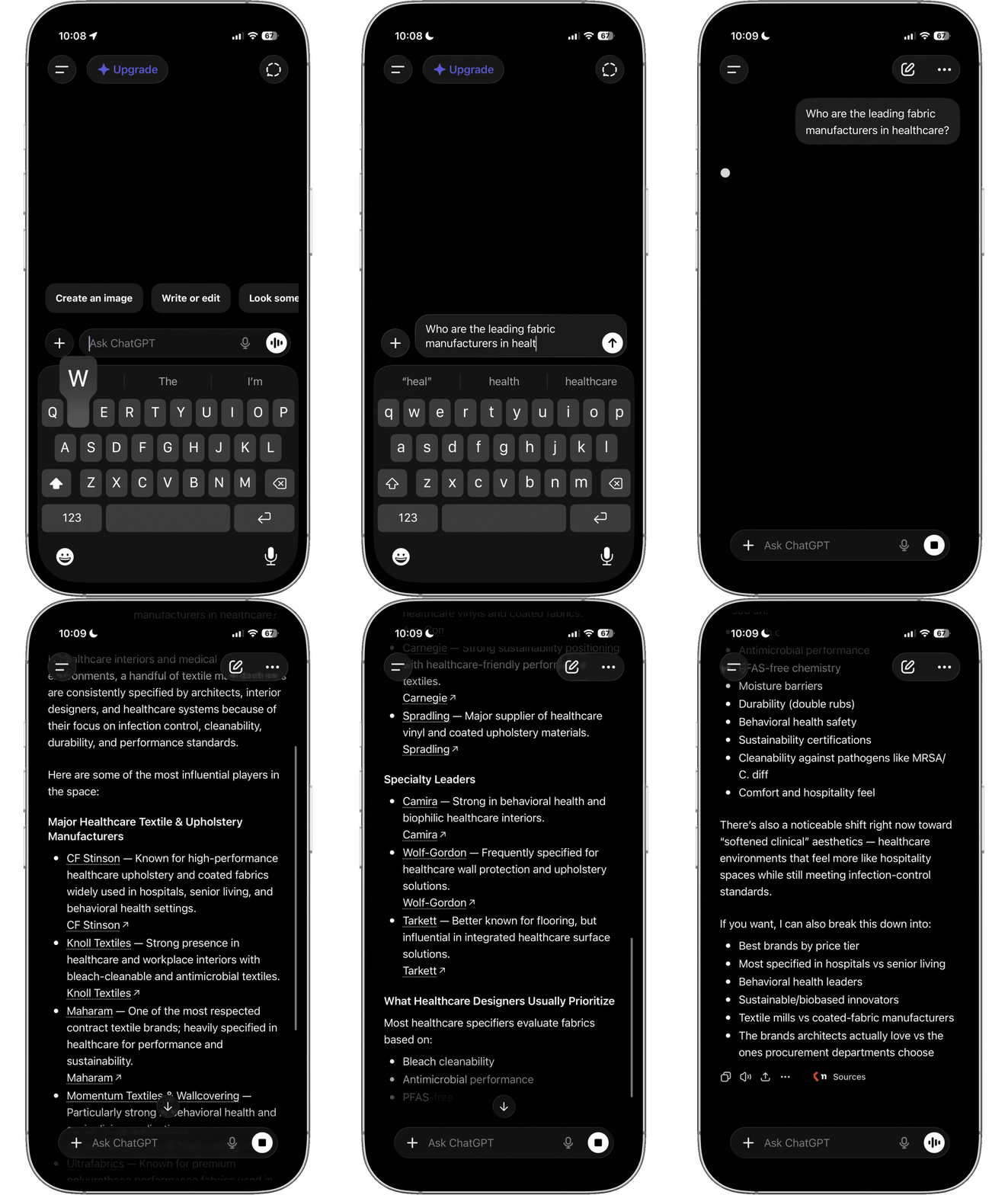
The shortlist used to start with a call. Now it starts with a prompt.
A hospital system's facilities lead asks ChatGPT for architecture firms qualified for a $200M campus expansion. A healthcare specifier asks Claude for the leading fabric manufacturers in her category. The names that appear in those answers are shaping shortlists and specifications before any RFP is written, and the firms and brands that don't appear never know the project existed.
AI didn't change which signals matter. Editorial coverage, awards, and thought leadership have always driven specification and firm selection in the architecture and design industry. AI tools are now reading the same signals, and the brands that have been building them are pulling ahead in spec rates and shortlist invitations.
We're already seeing categories consolidate around an early set of AI-recommended brands. The longer you wait to build the signals, the more expensive it becomes to displace them.
01 Know where you stand against the firms and brands beating you to shortlists and specs. AI Visibility Ranking and Competitive Citation Analysis across ChatGPT, Gemini, Perplexity, and Google AI Overviews. Scored prompt by prompt, with the signals your competitors have that you don't.
02 Hear what your buyers are actually asking before they ever reach out. ICP Deep Dive & Prompt Analysis built on real prompts for your category, whether they're choosing a firm or specifying a product.
03 Get your marketing, sales, and business development teams on one plan for the next 90 days. Working Strategy Session that turns the findings into a shared next move with your leadership.
04 Leave with a plan you can start executing tomorrow. Prioritized Action Roadmap ranked by business impact and effort, sequenced for the wins that move pipeline first.
Seven signals decide whether AI recommends you. We measure each against your real competitors.
01 Website Content Built for AI. The source AI quotes from. If it can't read your work, you lose the recommendation.
02 LinkedIn Presence. AI tools cite LinkedIn heavily. Quiet leaders get skipped when buyers ask who to talk to.
03 Press & Editorial Coverage. Where AI validates you. One real feature beats ten releases in publications AI actually cites.
04 Thought Leadership. AI repeats what's distinctive. Generic content blends in; original frameworks and POVs get cited by name.
05 Entity Consistency. Mixed details get you confused with another firm or brand, or skipped entirely.
06 Directory Presence. AI builds its "qualified players" answer from a short list of industry directories. Missing means invisible.
07 Awards in Indexed Databases. An indexed award compounds for years. A closed-list win AI can't read does nothing.
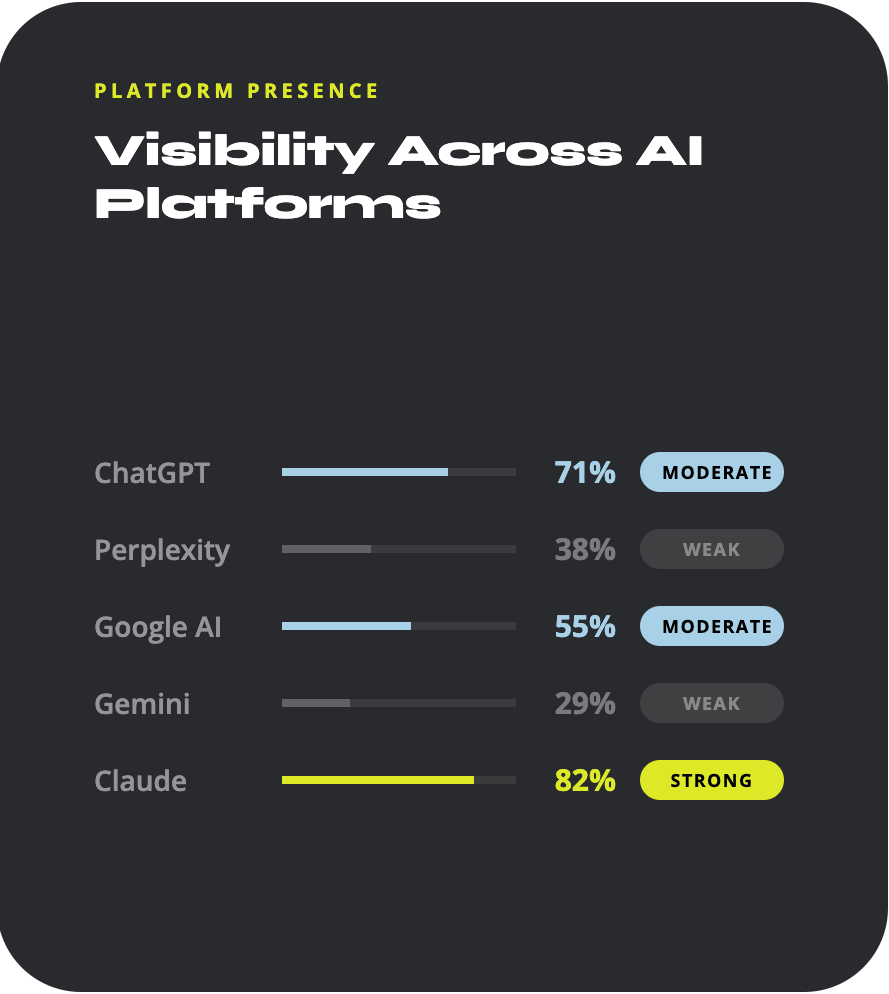
A Look at
What We Find
A tile manufacturer with a decade of pool and spa installs was showing up in only 27% of the prompts its buyers were running in that category.
In the prompts where it did not appear, the same competitors did: brands that had built sector-specific pages, named project data, and a press cadence in publications that covered the sector.
The firm had the work. AI did not see it. The clients, the case studies, the press, the proof points were all built in code the model could not read.
The audit named the signals invisible to AI and the order to fix them.
Who You'll Work With
Every audit is led by a senior UpSpring strategist with deep experience inside the architecture, design, and building product industries. The people who scope your audit are the people who write your roadmap.

Sarah Terzic
Co-Founder & President

Dayna Prepis
Vice President, Digital Marketing
17 years exclusively in the architecture, design, and building product industries.
Before you get started.
What is an AI Authority Audit?
An AI Authority Audit measures how often ChatGPT, Gemini, Claude, and Google AI Overviews recommend your firm or brand when buyers ask category questions in architecture, interior design, and building product manufacturing.
We score seven authority signals—website content, LinkedIn, press and editorial coverage, thought leadership, entity consistency, directory presence, and indexed awards—against your real competitors. You leave with a prioritized roadmap to win more shortlists and specifications.
How is this different from an SEO audit?
Different discipline. SEO measures how Google ranks your web pages. This measures how AI systems perceive and recommend your brand when buyers ask category questions. Editorial coverage, third-party validation, and thought leadership matter far more than backlinks or keywords.
How is this different from an AI visibility tracking tool?
The tracking data is increasingly commoditized. The interpretation isn't. Software tells you where you rank. It can't tell you which trade publications will move your category, which awards reinforce the position you want to own, or which thought leadership angle a reporter at Architectural Digest will say yes to. We've spent 17 years inside the built environment. We sit on both sides of the specification table.
Can I run this myself?
You can ask ChatGPT about your brand, but that's not an audit. We're tracking across multiple AI platforms over weeks with category-specific buyer prompts, then layering in competitive analysis, authority signal mapping, and citation data. More importantly, the data alone isn't the value. Our 17 years of category knowledge turn the rankings into a plan that moves your business.
What's involved on my end?
A discovery call to understand your business goals and competitive landscape. Context on your primary categories, key competitors, target markets, and current priorities. After that, we handle everything.
Is this only for large firms or manufacturers?
No. Mid-size firms and emerging manufacturers often benefit the most because AI isn't yet dominated by legacy brands in many built environment categories. There's a first-mover advantage for businesses that build authority signals now.
What happens after the audit?
You get a roadmap you can execute independently or with us. If you want UpSpring to execute it, we'll put together a proposal, and your audit fee credits against the retainer. There's zero pressure either way. The audit is a complete, standalone deliverable.
How quickly will I see results?
It depends on the signal. Website fixes and content rewrites are the fastest-moving; improvements can show up in AI answers as soon as the platforms re-index your site. LinkedIn activity and entity consistency typically begin showing impact inside a quarter. Editorial features, indexed awards, and thought leadership build over multiple quarters and compound from there. The roadmap sequences the fastest-moving signals first so you see measurable shifts before you've finished executing the rest.

We build the authority that gets your recommended, specified, and selected.
Strategic communications built exclusively for the architecture, design, and building product industries. We know how shortlists form, how specifications happen, and what drives selection decisions in your world
Carnegie Fabrics Teknion DLR Group. NanaWall TPG Architecture HLW Ultrafabrics Arcadis JCJ Architecture Brava